Which heat source a pet needs depends on the species, and every one needs a thermostat. Pick your pet for the heat source its vet and welfare care sheets give, and the thermostat that goes with it.
What are you heating?
Heat source
As an Amazon Associate, What Do Pets Need earns from qualifying purchases.
Every heat source needs a thermostat
RSPCA says a thermostat must be used with all heat sources, Merck and the NSW code also call for thermostats, and VCA wants one on a heating pad. Match the thermostat to the heater. For a heat lamp, RSPCA uses a dimming thermostat with its probe above the substrate; for a ceramic heater, a dimming or pulse proportional one; and for a heat mat, an on/off thermostat with the probe directly on the mat.
Zoo Med, which makes the ReptiTherm heat mat, recommends a thermostat or rheostat with it if your home reaches 80 °F or warmer. The vet and welfare sources put a thermostat on every heat source, so use one either way.
Heat lamps
A heat lamp sits above one end and warms a basking spot. Merck lists incandescent bulbs, infrared devices, mercury vapor lamps (which also give UV) and ceramic heat emitters, and says to use heat lamps with extreme caution because overheating is common. A ceramic heater gives off no light, which is why RSPCA uses one for heat at night. A heat bulb doesn’t necessarily give off UVB.
Guard every lamp so the animal can’t touch it or curl around it, and isn’t hurt if the bulb shatters. The distances differ by source: Merck puts lamps more than 18 in (45 cm) above the ground covering, VCA keeps a snake’s heat source at least 4–6 in from the highest spot it can reach, and RSPCA keeps a bearded dragon’s back at least 25–30 cm from its bulb.
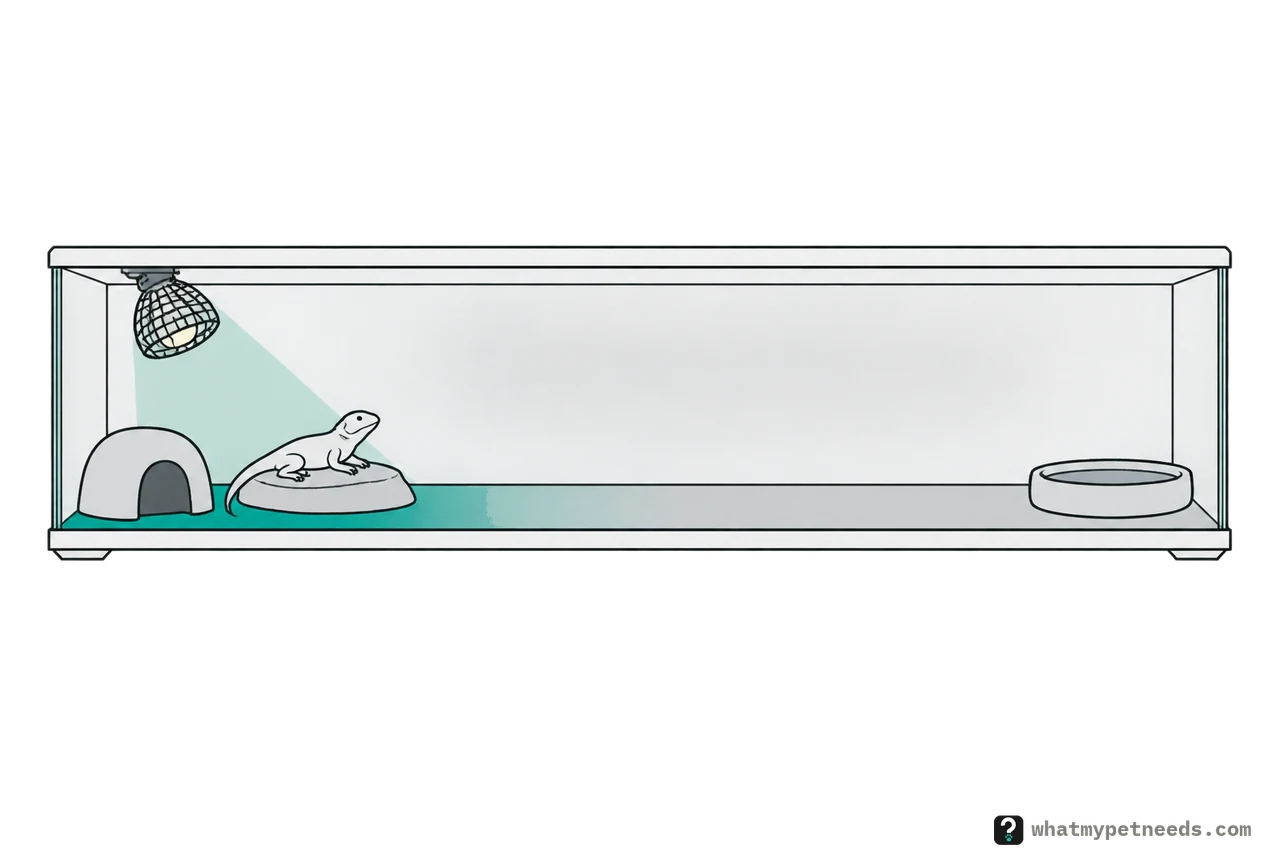
Heat lampat one end, guardedBasking spot
The lamp over one end warms the basking spot. Its guard keeps the animal from touching the lamp or curling around it, and from being hurt if the bulb shatters.
Heat mats
Where a heat mat goes depends on the animal. RSPCA puts one under half the base of a glass vivarium for a leopard gecko’s night heat, Yarmouth on the side of a pacman frog’s tank, and The Unusual Pet Vets on the outside of the back wall of a hermit crab tank. Merck says an under-tank heater should cover no more than 30% of the floor, so the animal can move off the heat, and should be made for reptile tanks.
Zoo Med warns that snakes and burrowing reptiles can push very light substrate, such as pine shavings or sphagnum moss, aside and lie on the glass right over the heater, where they can be burned. It says to lay its Eco Carpet down first.
Burns and hot rocks
The Unusual Pet Vets says burns from direct contact with heat sources are some of the most common causes of illness in reptiles. Heat rocks and mats often malfunction and overheat, so it usually doesn’t recommend putting them inside the enclosure. VCA and Merck advise against hot rocks too, and so does Aliso Beach Animal Clinic for hermit crabs. Zoo Med says its ReptiCare rock heater has no hot spots, and that a rock heater should never be the only source of heat.
Common questions
Can I use a heat mat instead of a heat lamp?
RSPCA, Yarmouth Veterinary Center and The Unusual Pet Vets use a heat mat for some pets and setups. RSPCA uses one in a hatchling corn snake's or ball python's small enclosure, and for a leopard gecko's night heat in a cold room. Yarmouth heats pacman frogs with a heat mat alone, and The Unusual Pet Vets heats hermit crabs with a heat mat or heat cord. For a gecko's, dragon's or snake's daytime basking spot, RSPCA and RVC use a lamp, and RVC uses a spot bulb for a tortoise.
Does a heat mat go inside the tank?
RSPCA, Yarmouth and The Unusual Pet Vets put it under or outside the tank. The Unusual Pet Vets usually doesn't recommend heat mats inside an enclosure, because they can malfunction and overheat.
Heat sources and thermostats come from RSPCA, the Royal Veterinary College, VCA, Merck, the NSW code and vet clinics’ care sheets; maker lines are Zoo Med’s, about its own heaters. Checked against published data from Royal Veterinary College, RSPCA, VCA Animal Hospitals, The Unusual Pet Vets and Zoo Med (plus 4 more).
See all 29 sources
RSPCA, Leopard gecko care
RSPCA, How to care for your bearded dragon
RSPCA, Caring for your crested gecko
RSPCA, How to care for a royal python
RSPCA, How to care for a corn snake
RSPCA, How to care for a terrapin (pond terrapins and sliders)
Royal Veterinary College (Beaumont Sainsbury Animal Hospital), Leopard gecko care, reviewed December 2024 (PDF)
Royal Veterinary College, Bearded dragon care, reviewed December 2024 (PDF)
Royal Veterinary College, Crested gecko care, reviewed December 2024 (PDF)
Royal Veterinary College, Royal python care, reviewed December 2024 (PDF)
Royal Veterinary College, Corn snake care, reviewed December 2024 (PDF)
Royal Veterinary College, Hognose snake care and advice, reviewed December 2022 (PDF)
Royal Veterinary College, Mediterranean tortoise care (Hermann's, Horsfield's, spur-thighed), reviewed December 2024 (PDF)
Royal Veterinary College, Terrapin care (red-eared terrapin), reviewed December 2024 (PDF)
Royal Veterinary College, White's tree frog care sheet, reviewed December 2024 (PDF)
Royal Veterinary College, Tarantula care, reviewed December 2024 (PDF)
VCA Animal Hospitals, Leopard geckos: care
VCA Animal Hospitals, Bearded dragons: housing
VCA Animal Hospitals, Aquatic turtles: housing
VCA Animal Hospitals, Snakes: housing
NSW Office of Environment and Heritage, Code of Practice for the Private Keeping of Reptiles (PDF)
MSD Veterinary Manual (pet-owner edition), Providing a home for a reptile
The Unusual Pet Vets (vet clinic, Australia), Australian land hermit crab care sheet, Coenobita variabilis (PDF)
The Unusual Pet Vets (vet clinic, Australia), Caring for Australian tree frogs (genus Litoria)
The Unusual Pet Vets (vet clinic, Australia), Thermal burns in reptiles (PDF)
Yarmouth Veterinary Center (vet clinic, US), Pacman frog care sheet
Zoo Med, ReptiTherm Under Tank Heater (product page)
Zoo Med, ReptiCare Rock Heater (product page)
Aliso Beach Animal Clinic (vet clinic, California), Hermit Crab Care Guide, medically reviewed by Bryan Hayter, DVM (last reviewed October 2026)
General care guidance from animal welfare charities, vets and makers' published sizes. It isn't veterinary advice: if your pet seems unwell or has eaten something it shouldn't, call your vet.