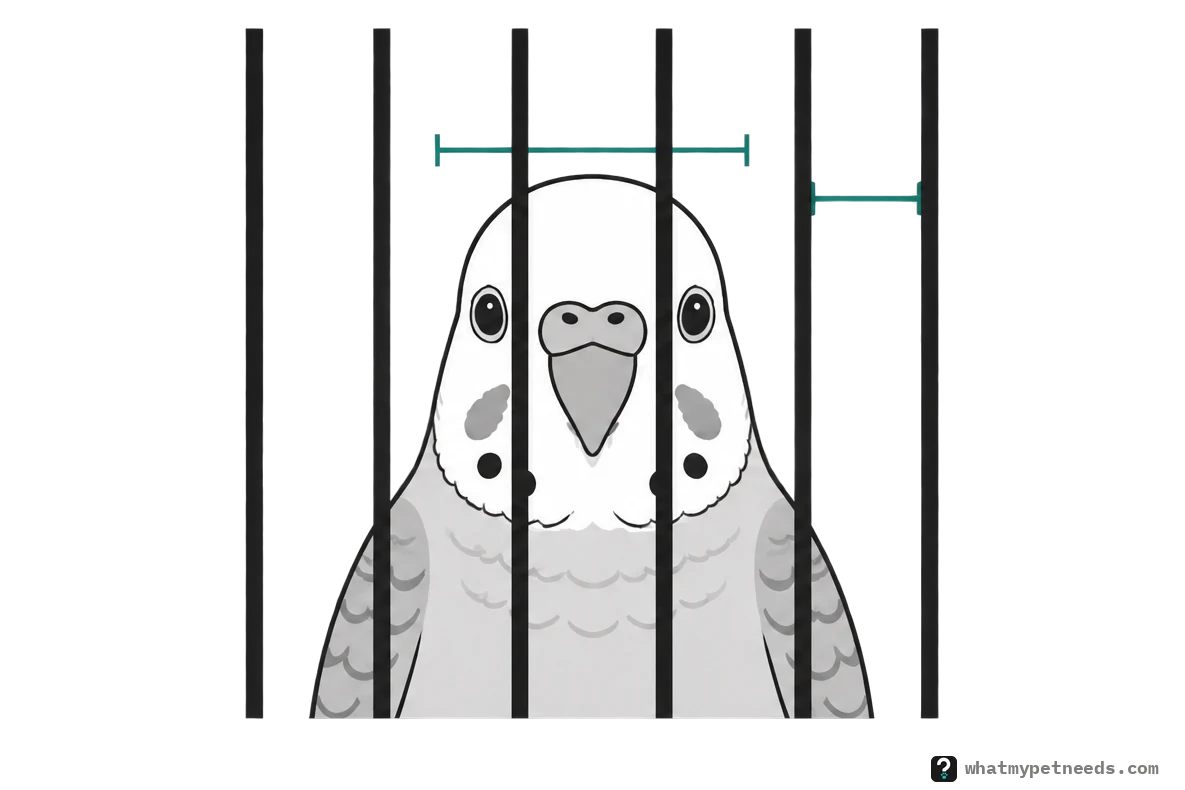
Budgies, cockatiels, lovebirds and parrotlets take bars 0.5 in (12.7 mm) apart, conures 0.75 in and macaws 1.5 in, by Merck’s table. Whatever the bird, it must not be able to fit its head between the bars.
Which bird?
Bar spacing
As an Amazon Associate, What Do Pets Need earns from qualifying purchases.
Why the gap matters
RSPCA Australia says the spacing between bars should not let a bird fit its head between them. VCA adds that the bars must be close enough to stop the bird getting its head or legs stuck. Merck pairs each spacing with a minimum cage, given as length by width by height.
Mesh for aviaries and small birds
RSPCA Australia says mesh size depends on the size of the smallest birds, and its table goes by weight.
| Bird size | Mesh opening | Wire thickness |
|---|---|---|
| Small (20–80 g) | 12 x 12 mm | 0.7–0.8 mm |
| Medium (80–200 g) | 12–25 x 12 mm | 1.24 mm |
| Medium to large (200–500 g) | 12–25 x 12 mm | 1.6–1.8 mm |
| Large (over 500 g) | 25–75 x 25–50 mm | 1.24–2.0 mm |
Its housing page puts wire another way: 16 gauge (1.6 mm) suits most medium sized parrots, and 17 gauge (1.7 mm) most small to medium sized parrots and finches. That page and the table differ on wire for small birds, 1.7 mm against 0.7–0.8 mm.
Finches and canaries
Merck’s table has no row for finches or canaries, so the head rule is the one to go by. RSPCA Australia’s smallest listed mesh, 12 x 12 mm for birds of 20 to 80 g, is just under 0.5 in. Cage sizes for them are on what do finches need and what does a canary need.