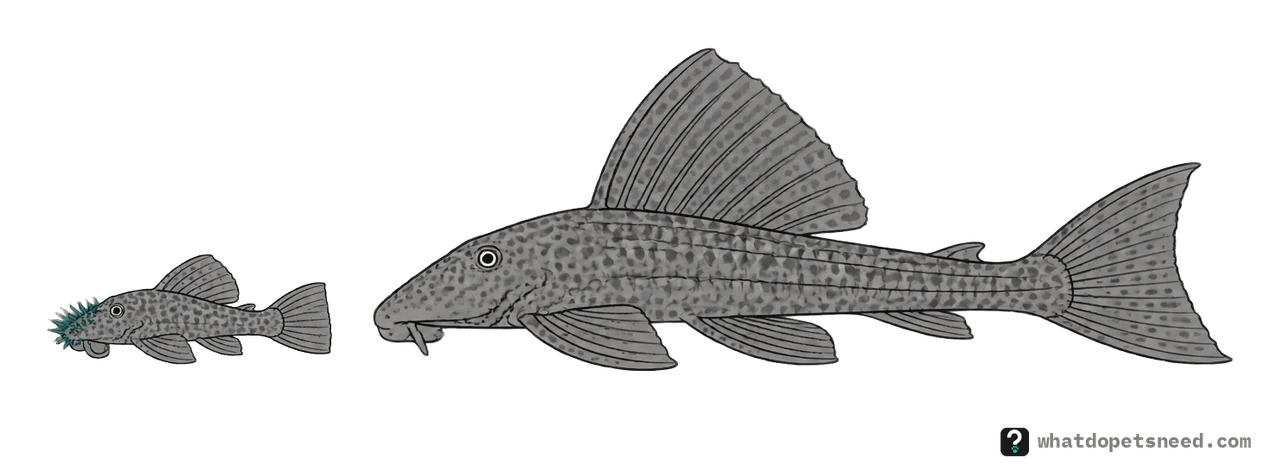
A bristlenose pleco needs a heated tank of at least 80 liters (21.1 gallons), with wood to graze on and somewhere to hide. Check which pleco you have first: the common pleco grows several times bigger.
Your tank
Your tank against each minimum
What to get
What to get
As an Amazon Associate, What Do Pets Need earns from qualifying purchases.
Bristlenose or common pleco?
Shops sell several fish as plecos. The bristlenose grows to about 15 cm (6 in), OATA says. Common and sailfin plecos are moderate to large fish of up to about 450 mm (18 in), the University of Florida says, and the U.S. Geological Survey gives sailfins as generally up to 50 cm.
Bristlenoseabout 15 cm (6 in)Common plecoup to about 45 cm (18 in)
Drawn to scale: a full grown common pleco is about three times the length of a bristlenose (OATA; University of Florida).
Plecos by adult size
Pleco
Adult size
Tank
Bristlenose
About 15 cm (6 in) (OATA)
At least 80 liters (21.1 gallons) (OATA)
Clown pleco
Unlikely over 10 cm (4 in) (OATA)
Wood is part of its diet (OATA)
Common pleco
Up to about 450 mm (18 in) (University of Florida)
At least 75 gallons (Aqueon, maker)
Sailfin pleco
Generally up to 50 cm (20 in) (USGS)
Often over 500 liters for tank busters (OATA)
Large plecos are sold small, and OATA warns that many of these tank busters grow very quickly, so make sure you can house the adult before you buy.
Males and company
Bristlenose can live alone, in pairs or in small groups, but OATA says it’s usually best to have just one male per group. Clown plecos are best alone or as a male and female pair, as two males are likely to fight.
Not a tank cleaner
Algae-eating fish aren’t a substitute for regular maintenance and sensible stocking, OATA says. A bristlenose grazes algae but still needs wafers and vegetables.
Never release them
Sailfin plecos released from aquariums now live wild in Florida, North Carolina and California, where the U.S. Fish and Wildlife Service rates them a high risk and the U.S. Geological Survey says their burrows can erode river banks. Bristlenose plecos are established in reservoirs and streams on Oahu, Hawaii. The U.S. Fish and Wildlife Service asks aquarium owners not to let fish loose into a local pond or river: it isn’t a harmless or humane way to part with them.
Common questions
How big do plecos get?
A bristlenose grows to about 15 cm (6 in), OATA says. Common and sailfin plecos reach about 450 mm (18 in), the University of Florida says.
Do plecos eat wood?
Many plecos do. The University of Florida says these catfish eat algae, insects, detritus and wood, and OATA says clown plecos struggle long term without wood in the tank.
Can a pleco live in a 10 gallon tank?
Not by OATA's minimum. A 10 gallon tank holds about 37.9 liters, under the 80 liters OATA gives even for the smaller plecos.
Care and tank sizes come from OATA, with Aqueon, a tank maker, named where used; adult sizes from the University of Florida, the U.S. Fish and Wildlife Service and the U.S. Geological Survey. Checked against published data from OATA, USFWS, NIST, RSPCA and USGS (plus 2 more).
UF/IFAS Extension, Freshwater Ornamental Fish Commonly Cultured in Florida (FA054, revised July 2023, PDF)
U.S. Fish and Wildlife Service, Don't Let It Loose
Aqueon, Plecostomus care guide (maker)
General care guidance from animal welfare charities, vets and makers' published sizes. It isn't veterinary advice: if your pet seems unwell or has eaten something it shouldn't, call your vet.